Monday, February 11, 2019

An Unforgettable, Unexpected Friendship Blossoms in the Green Book Film Review

A Feel-Good Road-Trip Drama 

GREEN BOOK A FILM REVIEW


by: Meanne M. Mijares
Cast: Viggo Mortensen, Mahershala Ali, Linda Cardellini
Director: Peter Farrelly
Studio: Universal Pictures
Genre: Drama
Rating: PG 13
Green Book is a period drama film set in the 1960s about a chauvinistic Italian American man (Viggo Mortensen) who takes a temporary job transporting a celebrated black pianist (Mahershala Ali) during his concert tour of the Midwest and Deep South. Called by some a “race-flipped Driving Miss Daisy,” the appealing story discovers how the two men had to put up with the so-called Green Book, a “traveling while black” guide to restaurants and accommodations that allowed black guests in the ’60s. Characters get beaten up and susceptible (including with a shotgun), there’s a fistfight, and two people are chained after being caught taking part in sexual activity (although nothing sensitive content was shown). There’s also quite a bit of language (including “s–t,” the “N” word, and more) and drinking/smoking. But the film’s messages about empathy and the danger of prejudice and stereotypes are important and challenging. And the story is an opportune reminder of how, just a few decades ago, there were whole parts of the country where isolation kept African Americans from fully contributing to civic life.
STORY IN DETAIL
Inspired by a true story, GREEN BOOK takes place in 1962 and shadows Tony “Lip” Vallelonga (Viggo Mortensen), a white, Italian American New York City bouncer who takes a temporary job chauffeuring black concert pianist Dr. Don Shirley (Mahershala Ali) as he travels throughout the Midwest and the Deep South on a concert tour. The movie’s title refers to a (now historical) guide for what Tony calls “traveling while black”: The Green Book is a handbook or index of restaurants and accommodations that make provision to African Americans throughout the separated South. As the uncouth, working-class, and admittedly racist Tony and the incredibly well-educated, intelligent Dr. Shirley get to know each other on the road, they challenge typecasts and grow to form an implausible friendship. But the farther down into the South they travel, the more they’re forced to deal with everything from Jim Crow laws to hate crimes.
POSITIVE CONTENT
The film's positive messages related to race, class and discrimination. It encourages people to look beyond prejudices to see people as individuals, not stereotypes. Even if some stereotypes apply (Tony is Italian and loves pasta and pizza), they shouldn’t be assumed (Dr. Shirley has never eaten fried chicken in his whole life). It argues that individual connection and friendship can break down barriers, discrimination, racism. Empathy is a strong theme.
Dr. Shirley is a pure genius, a first-rate musician who takes the time to help Tony better himself in writing love letters to his wife while they are on tour. He’s also an example of a man that is doing his best to confront stereotypes about black men in Jim Crow South. Tony doesn’t let his racism get in the way of taking the job, and in connecting with Dr. Shirley. They both learn to look past prejudices and form an dubious but strong bond.
VIOLENT CONTENT
There was a fistfight after verbal confrontation in and in front of nightclub. A black man gets beaten up in a bar for no apparent reason. Tony threatens to pull out a gun to defend Dr. Shirley; the bartender then pulls out shotgun. Police officer stops Tony and Dr. Shirley’s car; after Tony punches cop, cop arrests both men, making indirect threats about “boy” being “his.” Men who engaged in sexual activity are caught, handcuffed.
SEXUAL CONTENT
A married couple hugs and kisses. Two people who were engaging in sexual activity are shown after the fact, naked but curled up so that no sensitive body parts are shown.
LANGUAGE
Frequent language includes two uses of “f–k,” plus “goddamn,” “s–t,” “a–hole,” “bulls–t,” “son of a bitch,” “Jesus Christ,” “bastard,” “pr–k,” “t-ts,” “hell,” “crap,” and “garbage.” “Christ” as an exclamation. Also many racial epithets: “eggplant,” “coon,” “boy,” the “N” word, “chink,” “spool,” “kraut,” “stooge,” and “brillo pad,” as well as “wop,” “guinea” and “hillbilly.” The word “colored” is used to describe black people.
ALCOHOLIC CONTENT
Tony smokes cigarettes incessantly. A woman sells cigarettes at a club. Adults drink alcohol in bars at meals, parties, and by themselves. Dr. Shirley drinks from a bottle of whiskey (presumably nearly the entire bottle) every night. He gets drunk at a bar.
CONCLUSION
Mortensen and Ali gave excellent performances that’s partly “bestie” comedy, that is part history lesson, and social commentary on friendship and racial issues. Director Peter Farrelly, best known for rough comedies like There’s Something About Mary, brings out the humor in Tony and Dr. Shirley’s exchanges; he lets the lead actors to stand out in entirely opposing ways. Mortensen, who reportedly gained more than 30 pounds for the role, dips himself in impressive Bronx audacity, a swagger, while Ali is a portrait of nuanced limit, with loads of emotion smoldering underneath the surface. Both depictions are award-worthy, as are Ali’s musical performances (he went through extensive piano training to pull them off).
It’s not easy to revisit a time in history when gifted black artists could entertain all-white crowds but not sit or dine among them — or even use the same bathroom. Dr. Shirley refuses to lower himself through rudeness or even by listening to popular music, and he completely understands that the moment he steps off stage, he’s “just another black man to the white audiences” who moments earlier celebrated his talent. While Tony isn’t in the role of the feared “white savior,” Green Book’s story is more about him than Dr. Shirley, who’s substantially more self-aware — and also more of a mystery. It was amiss that Dr. Shirley’s personal life that does not delve into by way of more than a couple of allusions to his alienated brother and a failed marriage and one emotional monologue about not fitting into either white or black society. Especially considering that viewers meet nearly all of Tony’s big  fat Italian family, including his more unprejudiced broad-minded wife, Dolores (Linda Cardellini), to whom he writes (with help from Dr. Shirley, of course) progressively poetic love letters from the road. To be honest, the whole movie is a love letter of sorts — to a friendship that’s a reminder that the world needs more empathy and human connection … with superb music no less!
Green Book won three Golden Globe awards, including best supporting actor for Mahershala Ali, best screenplay, and best motion picture—musical or comedy not to mention the Screen Actors' Guild Awards. 
Overall, I rate the film 4 out of 5 stars.

Monday, January 21, 2019

DO YOU REMEMBER “NIÑO”? 

NIÑO: GMA Network’s Former Drama Hit Series Inspired Loyal Viewers

Meanne M. Mijares
Nino Show Title Card 
The Feast of the Santo Nino is being celebrated every third Sunday of the month of January throughout the Philippines as well as in Prague, Czechoslovakia, Eastern Europe. In the Philippines, we celebrate it through the Sinulog (Cebu) and Dinagyang (Iloilo) Festivals.  
Five years ago, there was a popular teleserye on GMA-7, a major TV network that was aired on its prime time block. Upon seeing the teaser plug, I felt a surge of excitement. From the first time I saw its teaser got aired, I knew it will be worth watching. And it was, indeed! In fact, when it finally debuted on national TV, its pilot episode garnered a rating of 21.2%! ABG Nielsen Philippines’ Mega Manila household TV ratings reported that the series had its highest rating on September 8, 2014 with 30.4 % while its last episode got a 29.6 % rating. 
The series was released from May 26 to September 12, 2014 with a total of 80 episodes with a running time of 27-38 minutes each. ‘Niño’ was a recommended daily dose of good entertainment on GMA Telebabad on weekdays after 24 Oras.
The creative team is composed of Creative Director, Jun Lana; Primetime Block Head, RJ Nuevas; Creative Unit Head Kit Villanueva-Langit; and Jules Katanyag as the Headwriter. Its ending theme titled “Liyab” was sung by Aicelle Santos.  Nino has a multiple-camera setup with a picture format of 1080i (HDTV)


You may ask, what made NINO truly worth watching?
Let me share with you 5 major factors why Niño was the best and must-watch family drama in 2014:
Top Caliber performers both from TV, film and stage with first-rate acting
From the veteran actors to the fresh new faces of Niño, no one can deny the combined acting prowess of the cast members. Whether they are making us laugh or making us bawl our eyes out, Niño’s stellar cast give their best every night.  Along with the winning formula of magical realism—the network introduces Miguel Tanfelix as the next big star, playing the title role. Truly he has captured our hearts with his effective portrayal of Niño, a mentally challenged 15 year old teenager with a positive attitude and a good heart who became a shining example of hope and inspiration to his town mates in Barangay Bagong Pag-Asa and prove that miracles exist with the help of his “Tukayo”, a Sto. Niño incarnate played by child star David Remo.
GMA Network was able to present a stellar cast that composed the country’s most respected artists in film and television: Ms. Gloria Romero as Lola V, Niño’s carefree grandmother; Dante Rivero as Don Pedro, Hannah’s father; Angelu de Leon as Leny, Niño’s adoptive mother; Jay Manalo as Lucio, Don Pedro’s adopted son and protege; Katrina Halili as Hannah, Jonathan’s wife and Niño’s kind-hearted mother; Neil Ryan Sese as David, Niño’s adoptive father; Luz Valdez as Tiya Epang, David’s aunt and Lola V’s best friend; Ces Quesada as Mrs. Santos, Tiny’s mother; and the late German Moreno as Kapitan Pete, the Barangay Captain of Barrio Pag-asa.
Renz Valerio as Rafael, Niño’s brother; Bianca Umali as Gracie, Niño’s best friend; Sandy Talag as Tiny, Niño’s chic friend; Julian Trono as Cocoy and Vincent Magbanua as Mat-Mat, Niño’s friends were the network’s fast-rising and talented teen stars and child performers joined the stellar cast
Jerald Napoles as Obet, David’s friend; Angeli Bayani as Belen, Leny’s close friend; Flora Gasser as Yaya Ason, Hannah’s loyal nanny; Rafa Siguion-Reyna as Ric, Lucio’s friend and right-hand man; Annika Camaya as Charito, Obet’s partner; Stephanie Sol as Olivia, Lucio’s girlfriend completed the line-up.
Playing an equally important role in Niño is the Kapuso Network’s leading man Tom Rodriguez as Gabriel, Niño’s hardworking father, who makes a special guest appearance in the TV series.
It was under the capable hands of the late veteran and award-winning director for both film and television—Maryo J. Delos Reyes whose goal is to wake up the Filipino televiewers’ sensibilities, stream of consciousness and hope via GMA-7’s drama series titled—NIÑO. Given Direk Maryo J’s undisputed track record of drawing his spectators with his kind of touch in such genre and based from his successful and FAMAS award-winning drama film Magnifico in 2003; he exceeded the expectations of repeating his winning streak in this primetime show.
A dose of good vibes in every episode!
With Niño, every night is a happy night. Niño is the family drama that doesn’t just make you let out tears of heartache but also tears of joy. The scenes we see each night on Niño are scenes that all people can relate to.
This family-oriented drama series features the heartwarming story of a boy who will inspire other people to remain hopeful in the midst of life’s challenges. Niño, as a character and show, will not only promote good family values but will also encourage viewers most especially the kids to become loving and optimistic at all times.

In the series, viewers saw how Niño was raised by his adoptive parents Leny and David after being separated from his biological parents Hannah and Gabriel because of an ambush, became a source of inspiration and hope to his town mates. Niño’s Tukayo will help and guide him in overcoming the different difficulties and problems in Barangay Bagong Pag-asa with courage and confidence. They are partners in encouraging the people to cope with life’s challenges with a child-like faith, appreciate life by becoming loving and hopeful always.
Though the concept may not be totally fresh, the network has brilliantly combined two successful inspirational-themed series—‘ May Bukas Pa’ (which ran for a year from 2009 to 2010) and ‘Budoy’ (which only lasted for five months—from October 2011 till March 2012). Both shows are from its rival network. Apart from such move—putting together the biggest and talented artists in this show is just right to back up the launching of Tanfelix’s career at that time.
Niño, which is made by the GMA Entertainment TV Group, is another first in the television industry for its original concept and educational plot. Under the helm of the late award-winning director Maryo J. delos Reyes with Conrado Peru as second unit director, Niño was a certified hit among Kapuso viewers and their families, most especially the young ones.
Niño was the new hero of his generation.
Niño Inocente is a fun-loving teenager who is close to his family and friends and was brought up by his adoptive parents, David and Leny Inocente, to be righteous and obedient. Niño, a mentally-challenged teenager, learns how to overcome obstacles along with his best friends, Gracie and Tukayo, and continues to inspire his community with his good examples. The prominent Sagrado family of Barangay Pag-asa is close with Niño, especially Hannah, unknowingly to her is Niño’s biological mother. Hannah hopes to be reunited with her long-lost son one day, who was separated from her. There are still many evil forces in Barangay Pag-asa, such as the Santoses and Lucio, the Sagrado’s loyal but scheming assistant. Niño and his father, Gabriel were separated from Hannah during an ambush caused by Lucio. The whole community gradually learns from their mistakes to become better, kind-hearted people and to stay strong in their faith.
Niño has become the ultimate role model of the youth. He was undisputedly the most lovable character on local TV. He makes us want to dream, to be hopeful, to be kind, and to love more.
Nino inspired many people to do and be good!
Niño definitely appealed to the family as it introduced the “Naynay Commandments”, a set of values and good manners that will teach the importance of being responsible and honest individuals and how these commandments can be applied in everyday life.
These “Naynay Commandments” inspired parents to raise their children to be hopeful and loving like Niño.
I believe the teleserye’s ‘Nay Nay Commandments’ will surely inspire the children to learn good moral values and help them mold their character and attitude as well. “Ang Sabi ni Lola V” at “Ang Mga Payo/Sabi Ni Tukayo” were segments the viewers awaited.
Every episode of Niño is filled with moral lessons not just for the youth but for everyone. It brings out the good in us. If Niño can be a good person, so can you. Being cool is not the new cool. It’s being good!
Courtesy of gmanetwork.com 
I would like to share with you a short comment I made on the top-rating show which was published in the Philippine Daily Inquirer Entertainment’s Saturday Special last June 7, 2014 through the Fans’ Day column of Andy Bais.  One memory my heart will always treasure is that from July 22-29, 2014, the comment was featured in the show’s TV plug and airs over GMA 7. By God’s grace, it crossed over from print to TV!

Published opinion/comment before the program's airing
Courtesy of the Philippine Daily Inquirer 


This is the online link from the Philippine Daily Inquirer Entertainment Section where the comment was featured 

https://entertainment.inquirer.net/144142/jessica-soho-shines-in-state-of-the-nation


Niño inspired us all.
Niño has inspired many viewers from its inception and continues to do so every day up to its final episode. The show received many messages praising the program and the lesson it aims to impart to the people. Viewers are grateful for the inspiration that Niño conveys to them.
Aside from its tested formula, it is very timely. People need inspiration and to have ‘hope’ in these tough, trying times. This series has all the elements that the viewers, particularly what the masses are looking for. With all the intrigues, the controversial issues happening in Philippine society; maybe Niño was the answer to divert and route all ‘negativity’ and turn it into something ‘positive’ instead.
This show may just also awake the youth of today that technology like online gaming aren’t the solution to escape the painful realities of life, rather strengthening one’s faith in Our Lord Jesus Christ. I totally agree with Direk Maryo J, this show offers something that uplifts our weary spirits. It inspires people who have entirely lost hope and rekindle it. What’s also important—the show instills good values and timeless life lessons.

Truly, GMA Network presented another original primetime treat that surely made a mark in the hearts of Kapuso viewers via the drama series Niño.
It was great to reminisce about the outstanding performances of the cast, feel the good vibes, witness small acts of heroism, getting the urge to do good deeds every day, and be inspired. Do all of these long after the TV series is over.
Thank you GMA 7 and especially to the people behind Nino! God bless and more power! 🙂


Friday, January 18, 2019

New Children's Short Story ANG MATALIK NA KAIBIGAN NI EMPOY Published by FilCatholic Magazine Online

ANG MATALIK NA KAIBIGAN NI EMPOY

Kwento ni Meanne Mabesa Mijares

Si Empoy ay isang batang nagtitinda ng sampaguita sa simbahan ng La Sagrado Familia kasama ng kanyang ina na si Aling Julia. Pilay siya kaya laging tinutuya at pinipintasan ng ibang mga bata na tulad din niyang nagtitinda ng sampaguita. Ngunit sa kabila ng lahat ng iyon, nakatagpo siya ng isang mabuti at matalik na Kaibigan.
Araw ng Linggo. Naghahanda na sina Aling Julia at anak nitong si Empoy na dalhin ang kanilang mga ititindang napakaraming mga sampaguita doon sa simbahan ng La Sagrado Familia. Mabango, mahalimuyak at kaaya-ayang tingnan ang mga maliliit at mapuputing mga bulaklak na may mga iba’t ibang kulay na laso sa gitna na maayos na nakalagay sa isang malaking timba na kulay pula.
Si Empoy ay isang batang pilay, kung kaya’t madalas siyang pagtawanan at pintasan ng mga ibang bata na tulad din niyang nagtitinda ng sampaguita. Dahil dito, wala tuloy gustong makipagkaibigan sa kanya. Ayaw nila itong isali sa kanilang mga laro’t kasiyahan.
Hindi na lamang niya pinapansin ang mga ito dahil mas mahalaga pa sa kanya ang tumulong sa ina sa paghahanapbuhay mula nung pumanaw ang kanyang ama sa isang malagim na aksidente at pagligtas sa kanya. Nahinto din siya sa pag-aaral.
“Empoy, tayo na sa simbahan at nang makapuwesto tayo ng maganda oras may bibili na sa atin ng mga sampaguita!”, sabi ni Aling Julia sa anak. “Andiyan na po, Inay,”tugon ni Empoy.
Dumating na sa simbahan ang mag-ina. Wala pang gaanong tao ang naroon. Pumasok muna sila at pinuntahan ang imahe ng Santo Nino na nasa sa kanang dako.  Taimtim silang  nanalangin dito. At pagkatapos, inilagay ni Empoy ang pinakamagandang sampaguita sa paanan ng Santo Nino at sabay na silang lumabas. Di nagtagal, marami nang mga tao ang pumapasok sa simbahan para sa misa.
Makalipas ang isang oras, may mga tao na namang bumili ng mga sampaguita mula sa mag-ina. Nakita ni Empoy na may isang nahulog na puting panyo mula sa isang nagmamadaling dalagita matapos abutin nito ang sukli mula kay Aling Julia. Paalis na ang dalagita nang habulin siya ni Empoy. “Ale, panyo po ninyo,” sabi ni Empoy. “Uy, salamat! Napakahalaga sa’kin nito…” Masayang ngiti ang kanyang itinugon sa bata.
Matapos tulungan ni Empoy ang ina sa pag-aayos ng mga panindang sampaguita, pumasok muna siya sa loob ng simbahan upang magdasal muli sa Santo Nino. Nakita ito ng ilang mga bata at sila’y nagbulungan at nagtawanan.
“Palibhasa’y walang kaibigan, kung kaya’t nakikipag-usap na lang siya sa rebulto, hindi
naman siya sinasagot. Hahaha!” sabi ng isa.
“Hay naku, kawawang Empoy! Lumpo na, sira pa ang ulo! Tsk…tsk…tsk!”dagdag pa ng isa.” “Sssssh!!!! Pwede bang ‘wag nga kayong maingay diyan at baka marinig pa niya tayo! Tara na sa labas, dali!” sabi naman ng isa.
Tapos nang manalangin si Empoy sa Santo Nino. Nagulat siya nang may isang Bata na umupo sa kanyang tabi at nakangiti. “Huwag mo silang pansinin, Empoy. Maging mabait ka lang sa iyong kapwa kahit hindi sila mabait sa iyo. Sa iyong pakikitungo sa kapwa, lakipan mo ito ng pagmamahal, mahirap man sila o mayaman.”
“Ano ang pangalan Mo?” tanong ni Empoy.  “Ako ang iyong Kaibigan.” Sabi ng Bata. “Lagi ka lang magdadasal at manalig sa Diyos, maging masayahin at palaging nakangiti. Huwag kang mawawalan ng pag-asa.”  “Maraming salamat sa Iyo, Kaibigan,” ngumiti rin si Empoy sa Bata at kinamayan ngunit pagkatapos, ito’y naglaho.
Hinanap ni Empoy ang Bata ngunit hindi niya ito nakita. Napadaan siya sa isa sa mga upuan nang may makita siyang payong na kulay bughaw na nakahiga. Napakaganda at makinang ito. Bagong-bago! May nakita siyang isang matandang babae na tila ba’y balisang-balisa. Kinuha ni Empoy ang payong at lumapit sa matanda.
“Sa inyo po ba ito?” sabay ngiti ni Empoy nang iniabot niya ang payong.
“Oo! Sa akin nga ito! Hanap ako ng hanap naiwan ko pala dito! Naku, kabibili ko lang nito! Akala ko nawala na!  Hay, salamat sa Diyos!” sabay alis ng matanda matapos mag-krus.
Bumalik na sa kanyang ina si Empoy upang tulungan sa pagtitinda ng sampaguita. Ngunit
pagkatapos ay muli siyang nagtungo sa altar ng Santo Nino upang manalangin dito.  Biglang naputol ang pagdarasal ni Empoy sa Santo Nino nang marinig niya ang isang ingay mula sa labas na tila ba’y nagkakagulo.
Paglabas niya ay kanyang nakita ang isa sa mga batang nanunuya sa kanya na may hawak na isang malapad at kulay dilaw na pitaka na puno ng napakaraming pera!
 “Huwaw! Tingnan ninyo! Tibang-tiba tayo dito! Ang dami! Kunin na kaya natin ito!”
Hindi nagdalawang-isip si Empoy na lapitan sila.
“Itigil nyo yan! Hindi tama ang kunin ang hindi sa inyo! Amina iyan! Isauli ko sa may ari!” giit ni Empoy.
“Sige, pilay! Habulin mo kami!!!!” sabi pa ng isa sabay takbong papalayo.
Tumigil lamang ang habulan nang may dumating na isang babaeng maganda, mabango’t nakapostura. Matangakad. Makinis ang balat. Balingkinitan. Tila mukhang mayaman.
Ipinahamak ng mga bata si Empoy. Pumaripas sila ng takbo at iniwan na lang basta ang pitaka  kay Empoy. Nabitawan niya ang dala nitong saklay at siya ay natumba. Kahit pilay-pilay itong maglakad, sinikap niyang abutin ang saklay upang isauli ang pitaka ni Mrs. Enriquez, isa sa mga nagbibigay ng donasyon para sa simbahan.
“Sa inyo po ba ito?”
            “Oo, akin nga yan.”
Iniabot ni Empoy ang pitaka sa babae.
 “Maraming salamat, iho!” Niyakap nito ng mahigpit si Empoy. 
“Mabait at tapat kang bata. Anong pangalan mo?
            “Empoy po.”
“Hindi ba’t nagtitinda kayo ng sampaguita  ng nanay mo ?” tanong ni Mrs. Enriquez.
“Opo.”
 “Sige. Dalhin mo ako sa kanya.”
Pagkalipas ng ilang taon, araw din ng Linggo, may isang magarang sasakyan ang bumaba sa tapat ng simbahan. Lulan nito si Mrs. Enriquez kasama sina Aling Julia at Empoy.
Wala na ang kanyang dating saklay. Ipinagamot siya ni Mrs. Enriquez kung kaya’t nakakalakad nang muli si Empoy at pumpapasok na sa paaralan bilang iskolar.  Si Aling Julia naman ay nagta-trabaho na sa isa sa mga kumpanya na pag-aari ni Mrs. Enriquez bilang kalihim.
Pagkatapos ng misa, bumili at pinakyaw nila ang mga tinda na sampaguita. Laking gulat ng mga dating kasama nina Empoy at Aling Julia pagkakita sa kanila dahil matagal nang huminto ang mag-ina sa pagtitinda. Subalit, nagbago man ang lagay nila sa buhay, nanatili silang mabuti at mapagpakumbaba.
Dali-daling nagtungo sa imahe ng Santo Nino ang mag-ina. “May dala kami para sa Iyo. Maraming salamat sa tulong Mo,” sabi ni Empoy.
Nang inilagay ni Empoy ang mga nabiling sampaguita sa leeg ng imahe ng Santo Nino, biglang lumiwanag ang buong paligid na nagmula dito! Lubos na galak ang nadama nina Empoy at Aling Julia, at maging ang iba pang mga deboto na tulad ni Mrs. Enriquez na nakasaksi sa napakaganda’t di malilimutang tagpong iyon.
Muling nagpakita kay Empoy ang Batang kumausap sa kanya noon. Siya ay lubos na nagalak pagkakita niya dito.“Kumusta ka, Empoy? Masaya Ako para sayo. May biyaya ang bawat pagsubok gaano man ito kahirap o kabigat. May nakalaaang gantimpala ang Diyos para sa bawat tao.”
Ngayon lamang napansin ni Empoy na tila may pagkakahawig ang Bata dun sa imahe ng Santo Nino. Ngunit bago pa niya ito tanungin, isang ngiti lang ang itinugon ng Bata at sabay naglaho.
Maya’t-maya pa’y lumapit kay Empoy ang mga batang nanunuya sa kanya. “Patawarin mo kami, Empoy. Kami ay naging sakim at makasarili,” sabay alay ng kanilang mga palad.
Malugod na tinanggap ni Empoy ang paghingi nila ng tawad at alok na makipagkaibigan. Ngunit sa puso niya ay nag-iisa lamang at bukod-tangi ang matalik niyang Kaibigan dahil tanggap siya Nito maging sino man siya at hindi yun magbabago kalian man-ang Santo Nino!

Sunday, January 13, 2019

MARY POPPINS RETURNS A FILM REVIEW

Still A Sweet Spoonful of Sugar 

MARY POPPINS RETURNS 

A FILM REVIEW

Meanne M. Mijares
Jesus looked at them and said,
“With man this is impossible, but with God all things are possible.”
Matthew 19:26 New International Version (NIV)


Cast    
Emily Blunt                             as Mary Poppins
Lin-Manuel Miranda                as Jack
Ben Whishaw                          as Michael Banks
Emily Mortimer                       as Jane Banks
Pixie Davis                              as Annabel Banks
Nathanael Saleh                       as John Banks
Joel Dawson                            as Georgie Banks
Julie Walters                            as Ellen
Dick Van Dyke                        as Mr. Dawes, Jr.
Angela Lansbury                      as The Balloon Lady
Colin Firth                               as William “Weatherall” Wilkins
Meryl Streep                            as Topsy
Directed by      Rob Marshall
Produced by    Rob Marshall, John DeLuca and Marc Platt
Screenplay by   David Magee
Story by           David Magee, Rob Marshall, John DeLuca
Based on          Mary Poppins by P. L. Travers
Distributed by Walt Disney Studios Motion Pictures
Genre: Family and Children
Run time: 2 hours and 10 minutes
Rating: PG
First of all, I would like parents need to know that Mary Poppins Returns, starring Emily Blunt as everyone’s beloved magical nanny and Lin-Manuel Miranda as Jack, her Cockney lamplighter pal, is a sequel to Mary Poppins, the Oscar-winning 1964 classic movie. As she did before, the flying, singing, lesson-imparting Mary arrives to help the Banks children — this time around, the three kids of a now grown-up Michael, whose wife died a year before the movie begins (he and the children speak and sing about missing her) and whose family home is in threat of reclamation. The follow-up advances from the first by including a clear scoundrel and limited scenes of danger /suspense (including a mostly animated but still anxious pursuit through a dark wood), though nothing ever gets too creepy. But it follows in the previous ‘s footsteps with its beguiling songs and durable messages about imagination, gratitude, empathy, kindness, looking past the surface, and — of course — being close to your family and believing in yourself.
THE STORY
Disney’s MARY POPPINS RETURNS is a musical set in the 1930s, more than two decades after the events of the previous Mary Poppins. Banks siblings Michael (Ben Whishaw) and Jane (Emily Mortimer) are now adults, and Michael, a recent widower, lives in his childhood abode with his three children — John (Nathanel Saleh), Anabel (Pixie Davies), and Georgie (Joel Dawson) — and their overburdened housekeeper, Ellen (Julie Walters). But he’s having trouble making ends meet in Great Depression-era England. The new generation of Banks kids are in for a treat when Mary Poppins (Emily Blunt) returns to Cherry Tree Lane to care for them and teach the entire family valuable lessons … with a little help from Cockney lamplighter Jack (Lin-Manuel Miranda). When the bank, under the new management of William Weatherall Wilkins (Colin Firth), calls Michael and Jane’s loan in, everyone does their best to ensure that the Banks family doesn’t lose their beloved home.
Image courtesy of Disney Philippines 


Educational Value
Viewers will learn about the brunt and blow of the Great Depression in the U.K. and how tough and grim economic times can affect people, as well as a few things about why Aunt Jane supports the labor movement.
Image courtesy of Disney Philippines 
Positive Messages
Mary Poppins uses daily obstacles and circumstances to teach the Banks children lessons about not judging a book by its cover — whether it’s an actual book or a person. Like the original, it encourages empathy, gratitude, the value of imaginative play, fun, hard work. Mary Poppins underscores the importance of children being children, adults embracing their childlike qualities. The songs’ messages all have character-building content — e.g., embracing your imagination, looking at things from a different perspective, knowing that even in tough times, there’s nowhere to go but up. The film encourages strong family bonds and believing in your abilities.
Image Courtesy of Disney Philippines 
Positive Role Models & Images
Mary Poppins is a woman of mystery and magic. She’s loving, caring and kind but also firm, with a dry sense of humor. She reaches each child where that child is. She’s the very portrait of an independent woman. She shows compassion, communication skills and integrity. Jack is positive, helpful, and yes, resourceful. The Banks children are impulsive but want to help their embattled father. Michael is overwhelmed by circumstances of his life but loves his kids, tries hard. Main bad guy is greedy, selfish but does seem to partially see the error of his ways. What I like about this film is that it has a diverse supporting cast.
Image Courtesy of Disney Philippines 
Violent Content
The children’s mother passes on; it happened a year before the movie begins, but they (and Michael) talk and sing about missing her. Potentially frightening scene in which young Georgie is taken captive by some ill-meaning animated animal creatures; there’s a tense carriage chase through a dark, creepy wood as his siblings try to rescue him. The kids go flying off “the edge of the bowl” and have to be saved. The suspense scene is when Jack climbs up the Big Ben tower and briefly sways high above the ground. A greedy man is mean to children and threatens them. There are some yelling and exchange of harsh words between Michael and his kids. The Banks’ neighbor regularly fires a canon.
Sexy Stuff
I have watched a couple of wink-wink double-meaning jokes/lyrics in a Vaudeville-like song-and-dance number (“she only wore a smile — plus two feathers and a leaf”) and a little hip-thrust dance move by Mary. There are some clear flirting exchanges between Jack and Jane.
Language
There were a few insults like “pea brain,” “fool,” and “buffoon,” plus British slang such as “bloody” and “blasted.”
Drinking, Drugs & Smoking
A song jokes about an uncle being “on the sauce.”
CONCLUSION
Blunt unquestionably owned Mary Poppins while also keeping nostalgic viewers happy with tributes to the original film in this whimsical, playful sequel. Director Rob Marshall loves making big-budget Hollywood musicals, and in Mary Poppins Returns, he ambitiously creates a delightful world that families with kids of all ages will be eager to dive into and enjoy. Everything from the amazing production design to the colorful costumes to the catchy, upbeat songs has still that Disney magic. The performances are all good, with Blunt paving the way. Miranda’s Cockney accent is a little subtler than Dick van Dyke’s was (British folks notoriously panned the lovable actor for his over-the-top attempt), and, refreshingly, there is hardly a hint of romance between his Jack and Mary. Instead, they’re old friends who show the three Banks siblings how to be imaginative and helpful. Whishaw and Mortimer are well cast as the grown-up Michael and Jane, and Meryl Streep memorably joins the proceedings as Poppins’ unconventional cousin, Topsy.
If there’s a comparatively frail spot in the film, it’s the plot, which is justly thin and foreseeable (many moviegoers will discover exactly where those missing bank documents are placed), but you don’t watch a Disney musical expecting Tinker Tailor Soldier Spy-style twists. The musical numbers are superb, and it’s a delight to see Blunt and Miranda sing and dance together. Hamilton fans are rewarded with the big, Miranda-led lamplighters’ song “Trip a Little Light Fantastic” (a clear successor to the original’s “Step in Time”), and his and Blunt’s stirring vaudeville duet “A Cover Is Not the Book” is also quite memorable. The lullaby “The Place Where Lost Things Go” is splendid, and “Nowhere to Go But Up” will make spectators reminisce the joy of “Let’s Go Fly a Kite.”
Summing up this throw-back film, Emily Blunt achieves a fruitful embodiment of the iconic nanny, Mary Poppins. The film, heavy laden with nostalgia and positive emotion, is overall well done. However, several elements stick out as sore thumbs among the art. In addition, the producers of Mary Poppins Returns create new songs which brilliantly imitate the spirit of each musical number in the original musical. The cantata which attempts to personify “Supercalifragilisticexpialidocious” is titled “The Cover is Not the Book” and presents a saloon-clad Mary replacing proper English for cockney. I’m sorry to say that the array of adult jokes through the number is a major turn-off. Honestly, this number is distracting, out-of-character and risque. Other elements in this film are just as falling short of the “practically perfect” film we, as a culture, have come to expect. But at the end of the day, Mary Poppins Returns will make us cry, bring a smile to our faces, kindle a sensation flying, and help us to recall what it is like to be a child again.
Will this sequel replace the original in moviegoers’ hearts? I doubt it. Because I must say, there is only one.
I rate the film 4 out of 5 stars.

Friday, January 4, 2019

The First Magi A Children's Short Story

THE FIRST MAGI

Meanne M. Mijares
Once upon a time, long before Melchor, Gaspar and Balthazar, went to Bethlehem to visit the Christ Child, lived a great but now retired prime minister named Ahashea who had spotted signs and wonders in the heavens; signs that no one had ever seen before. These premonitions announced the coming of the greatest King of Kings one would ever know. Amazed by the prospect of such great power, Ahashea chose to set off in pursuit of this King, expecting to place himself at the King’s service, and thus attain a position of high importance in His future kingdom.
Assembling all his possessions, he formed a vast convoy and they moved off towards where the signs point out. But the influential prime minister didn’t know how long and hard the expedition would be.
Most of his servants got sick, and Ahashea cared for them, spending great wealth on healers and doctors. They crossed such dry country that the dwellers were dying of hunger, by the dozen. Ahashea allowed these people to join his caravan, and provided them with food and clothing.
They met slaves that were so terribly mistreated that Ahashea decided to buy their freedom, estimating him huge amounts of gold and jewels. The thankful slaves also joined Ahashea’s team.
So long was the journey, and so many people ended up joining the convoy, that when they finally arrived at their destination, only a small portion of the jewels were left; jewels that Ahashea had reserved as a gift for the great King. He then discovered the final sign: a big, shining star, rising up from behind some hills, and headed towards it with the last of his riches.
He walked towards the great King’s palace and came across many travellers, but against his expectations, few of them were noble, powerful people; most of them were shepherds gardeners, and poor people. Seeing their shoeless feet, and thinking of what little use such a powerful King would have for his few riches, Ahashea ended up sharing the last of his jewels with these poor people.
Without a doubt, his plans had gone wrong. Now he couldn’t even submit an application for a good post in the new Kingdom. Ahashea thought of going home, but he had been through a great deal to get there that he didn’t want to leave without at least seeing the new King of Kings.
So he kept on walking, and saw that after a bend the road came to an end. There was no sign of palaces, soldiers or horses. All he could see was a small stable at the side of the road, where a poor family was trying to shield themselves from the bitter cold. Ahashea was dissatisfied at having got lost again, and he move toward the stable, meaning to ask these people if they knew the way to the new King’s fortress.
“I bring a message for the King,” he explained, showing them a parchment, “I would like to serve him and have an important place in His mighty kingdom.
Upon hearing this, they all smiled, most especially a newborn Baby who was lying in a manger. The Lady in the stable held out her hand and taking the message, smiled and said:
“Give me the message, I know Him, and will give it to Him personally.”
She gave the parchment to the Child who, to the sound of everyone’s laughter, squashed it with his little hands and chewed it, putting the parchment beyond repair.
Ahashea didn’t find this funny. Thinking that he now had nigh on to nothing, he fell to the floor, weeping bitterly. While he was sobbing, the Baby’s hand touched his hair, as if to comfort him. Ahashea lifted up his head and looked at the Child. He was quietly smiling, and was such a beautiful happy Baby that Ahashea soon forgot all his worries and cares and began playing with Him.
He stayed there for almost the entire night, in the presence of the poor family, telling them of his travels and adventures, and sharing with them what little he had left. When daybreak arrived, Ahashea got up and was ready to leave, bidding goodbye to all and kissing the Baby. The Child, smiling as He had done the whole night through, took the damp parchment and glued it in Ahashea’s face, making them all laugh. Ahashea took the parchment and kept it as a memento of that delightful Holy Family.
That day, Ahashea, the first Magi, began his journey back home. Several days later, remembering his evening in the stable, he stumbled on the parchment among his clothes, and opened it. The Baby’s saliva had left no trace of the special message.
But right at that moment, while he was looking at the blank paper, there were tiny drops of water and gold ink filled the air around the parchment and slowly came to rest on it.
 With tears of happiness rolling down his cheeks, the former prime minister read:
“My son Ahashea,  I have received your message. Thank you very much for coming, and for all the gifts you brought for My friends who you met on the way. I guarantee you, that you already have a Grand Place in My Kingdom.
Signed: Jesus Christ, the King of Kings”

Tuesday, December 25, 2018

DO YOU REALLY HAVE JESUS THIS CHRISTMAS?

DO YOU REALLY HAVE JESUS THIS CHRISTMAS? Ang Dalawang Hapag (A Christmas Reflection on the late Joey Velasco’s Two Banquets-Hope and Love)

by Meanne M. Mijares
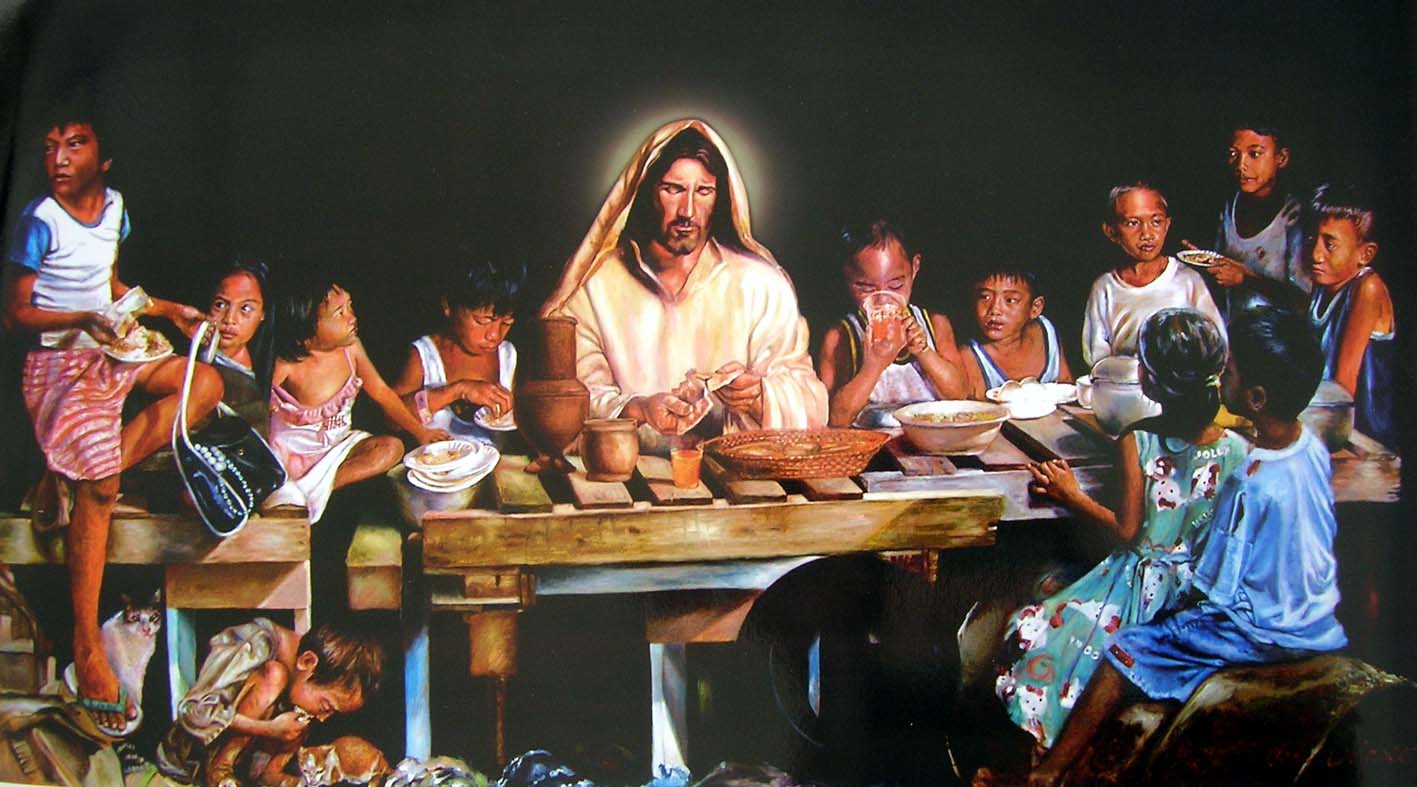
HAPAG NG PAG-ASA painted by Mr. Joey Velasco
It will soon be Christmas and we all know that Jesus Christ our Lord is the true reason of the season. Year after year, we are always being reminded of this truth. During the preparations for this much-awaited day, I am being strongly drawn to two, yes two, paintings by the late former Salesian seminarian, businessman-turned-visual “heartist” (an artist who creates art from the heart, since he did not receive formal training as a painter.) and philanthropist Joey Velasco and that for me, sum up what Christmas is about because Christmas is a joyous celebration with so many banquets and celebrations being held all over the world. But I would like to share my two cents’ worth on the two banquets he painted about-hope and love.
His paintings Hapag ng Pag-asa (Banquet of Hope) and Hapag ng Pag-ibig (Banquet of Love) spoke many volumes indeed about the love of God. Hapag ng Pag-asa, most especially called attention to the entire country and it was reprinted into postcards, calendars, and posters for every Filipino household. Indeed, Sir Joey was not only able to change his life but also the other faithful who were moved with his works and were inspired to do something for the poor and marginalized. It looks a simple painting but carries a very powerful message. The Lord used the “heartist” in Sir Joey and the transformative power of art to call people together to put love into action to awaken the message of love, sharing and generosity in our slumbering, parched and weary souls-with of course, the help and grace of our Lord no less.

“Hapag ng Pag-asa” is about twelve street children, representing the Filipino folk instead of His twelve apostles who invited our Lord to share a meal with them. The children many not have enough but they anchored their lives and hopes in Him. What makes the painting so special is because of the loving presence of our Lord who knows all our hurt, sufferings and problems that we face in our lives. We see ourselves in the plight of these twelve children also clinging to Him who knows the desires of our hearts, who has the power to answer our prayers and solves our problems beyond our dreams. Through this painting, Mr. Velasco reminds his children and to all of us as well about the importance of food consumption and avoidance of wastage as hunger is a problem rooted by greed. It also reminds us to put Christ our Lord at the center of our lives, whether it is Christmas season or not.


“Hapag ng Pag-ibig” is the follow-up to the earlier work and represents the children in an innocuous safe place where they are loved and cared for. This was painted during the time when shelters were being put together to take in the children and their families. Mr. Velasco was said to give color to each child’s visual rendering when each unit was being constructed in Hapag Village located in Amparo, North Caloocan. In reflecting on this painting, it says that in eternal life, we enjoy the loving company of our Lord. Where there is no more hurt, pain, hunger or thirst only happiness, joy and peace infusing the beauty and grandeur of Heaven.
In summary, these paintings and other previous works turn out to be more than just a platform of Mr. Velasco’s masterpieces. It is an eye-opener to the plight of the needy, oppressed and troubled. In due course, it is a representation of Jesus Christ-the real Emmanuel, dwelling in our midst.
They say art imitates life. But for Sir Joey, art transforms life. Considering himself a “socio- spiritual realist”, as he made artworks to reveal the realities of life, he reinvented the visual landscape to make known his own tale of hope and healing and by bringing the Lord Jesus closer to the Filipino people.  
His paintings empower us to partake of His banquet of hope on earth so that we may have a generous share of His greatest banquet of love in Heaven. May our hearts be buoyed up with hope and love all year round, all the days of our lives. May we always celebrate a joyful Christmas with Jesus truly alive in and with us!

Thursday, December 20, 2018

Being First Aint't Really Easy A Film Review on "FIRST MAN"

IT’S NOT EASY TO BE FIRST “FIRST MAN”: A FILM REVIEW

The First ManBy Meanne M. Mijares

Sitting down, Jesus called the Twelve and said,
“Anyone who wants to be first must be the very last, and the servant of all.”
Mark 9:35 (NIV)

So the last shall be first, and the first last: for many be called, but few chosen.
Matthew 20:16 King James Version (KJV)
Cast
Ryan Gosling              …         Neil Armstrong
Claire Foy                   …         Janet Armstrong
Jason Clarke                …         Ed White
Kyle Chandler             …         Deke Slayton
Corey Stoll                  …         Buzz Aldrin
Patrick Fugit               …         Elliot See
Christopher Abbott    …         Dave Scott
Ciarán Hinds               …         Bob Gilruth
Olivia Hamilton          …         Pat White
Pablo Schreiber           …         Jim Lovell
Shea Whigham …         Gus Grissom
Lukas Haas                 …         Mike Collins
Ethan Embry               …         Pete Conrad
Brian d’Arcy James     …         Joe Walker
Cory Michael Smith   …         Roger Chaffee
Kris Swanberg             …         Marilyn See
Directed by Damien Chazelle
Screenplay by Josh Singer
Based on the book by James R. Hansen
Distributed by: Universal Pictures
Genre: Drama
Rating: PG-13
First Man is Oscar-winning director Damien Chazelle’s (La La Land) serious, fact-based movie about distinguished astronaut Neil Armstrong. It’s set during the stormy decade leading up to his significant Apollo 11 moon mission. Ryan Gosling stars as Armstrong, the smart, brave, strong-minded, extremely enduring engineer-pilot-astronaut who endured to eventually become the first person to walk on the moon. Along the way, he and NASA must get through life-threatening circumstances including mission fiascos, hazardous test flights, and even the demise of esteemed team members — but this is more of an crafty character study than an Apollo 13-style page-turner. Expect social drinking, chain smoking, infrequent but memorable swearing (including “s–t,” “damn,” and one “f—ing”), and several tense, sad scenes of characters in danger. A child’s passing isn’t presented, but the impression is clear. Claire Foy co-stars as Armstrong’s wife, Janet, who has a bigger role here than many “NASA wives” in relatedly themed films. Some scenes were shot with a handheld camera in a way that can be quaking.
THE STORY
FIRST MAN is Academy Award-winning Damien Chazelle’s film bio about Neil Armstrong (Ryan Gosling). It took place between the years 1961 and 1969, those years that took Armstrong from being a test pilot in California to a groundbreaking NASA astronaut in Houston to the first person to walk on the moon. While he’s still flying planes in the Mojave desert, Neil and his wife, Janet (Claire Foy), suffer the loss of their daughter, Karen, who dies from brain cancer. Neil is then employed to officially join NASA’s space program in Houston. There, he and Janet make friends with the other astronauts, like Ed White (Jason Clarke), Elliott See (Patrick Fugit), and Jim Lovell (Pablo Schreiber), and their families as the men go on board on often precarious missions be in charge of up to the race to the moon.
Positive Messages
The film celebrates traditionally American values such as competition, pioneering spirit, courage, teamwork, hard work — all of which came into play to win space race to moon. It depicted how Armstrong’s humility, quiet strength, determination helped make Apollo 11 a fruitful mission.
Positive Role Models & Representations
Armstrong is a keen, brave, strong-minded engineer, pilot, and astronaut. He loves his wife and children but is also focused on his NASA mission. The astronauts are kind, reassuring, even though they’re also vying for slots on the moon mission. Janet is a caring, enduring, loving wife and mother.
Violence
More than a few deaths occur due to mission/equipment failures – and they take place off camera. In one case, lead-up to the deaths is shown, with astronauts worrying, yelling for help as fire breaks out. There were edgy scenes in which astronauts in space have to prevail over troubles that could have life-threatening results. Karen’s death is veiled; her petite casket is shown during a wake.
It is natural that a married couple dances, embraces, kisses but done in good taste. I have observed occasional strong language includes “holy s–t,” “damn,” “screw,” “jackass,” “hell,” “Jesus Christ!,” and one “f—ing.” I have also seen adults drink beer at a couple of get-togethers/dinners while some adults do chain-smoke.
CONCLUSION
Gosling gives an excellent feat as the thoughtful, intelligent space pioneer in this warm, primordial but thoughtful biopic. Chazelle’s adaptation of James R. Hansen’s novel of the same title First Man: The Life of Neil A. Armstrong is a very personal discovery of Armstrong’s life in the 1960s. The movie opens with a uncomfortable, terrifying, dizzying test flight on the rocket-powered X-15 — a scene that’s contrasted with a upsetting sequence in which it’s clear that Neil’s little girl is ill. After her death, Neil hardly lets anyone see him break down, and that impassiveness about loss lasts throughout the years as he endures the death of his fellow pilots and astronauts who weren’t only colleagues but good friends. Gosling is a masterful thespian: one who never overacts and seems to truly comprehend the art of restraint. It helps that Armstrong isn’t an alpha male space herdsman or an go-getting and outgoing like Buzz Aldrin (Corey Stoll); he’s humble, hardworking, and at times emotionally aloof.
Although the movie offers plenty of nail-biting moments and picturesque cinematography (especially in the space/rocket scenes), this character study isn’t as similar to Apolllo 13, Gravity, or The Right Stuff as moviegoers might expect. Chazelle keeps the film focused only on the two Armstrongs, without trying to pick up every major event or figure involved in the space race. Unlike many other fact-based films about that time, which only cursorily include the astronauts’ wives, Chazelle gives Foy’s Janet plenty of screen time as the wife left behind to keep the house spic and span, calm down her frazzled nerves, and hope that her husband doesn’t become another NASA fatality. The film is buoyed by an excellent supporting cast and production and creative teams — First Man attests that Neil Armstrong is a uniquely self-effacing and modest celebrity and that Chazelle is one of the most multitalented filmmakers.

Cassy's Chair is Meanne Mabesa Mijares new children's book!

Cassy is a cheerful and friendly girl. She is raring to have many friends in school. There is nothing wrong with that, actually. But her w...